The Problem with Pet Odours in Carpet
If you have a dog or cat, you've almost certainly dealt with a urine accident on the carpet at some point. You clean it up, spray on a supermarket odour eliminator, and think the problem is solved — until a warm day arrives, or you turn on the heating, and the smell comes flooding back.
This is one of the most frustrating experiences for pet owners, and it happens because the source of the odour was never actually removed. Understanding why pet urine smells so persistent — and what it takes to truly eliminate it — is the first step to solving the problem for good.
Why Pet Urine Is So Difficult to Remove
Pet urine is a complex biological substance. When it first contacts the carpet, it's relatively easy to blot up the liquid. But the problem is what happens next.
As urine dries, the liquid evaporates — but the urine crystals (uric acid salts) remain behind. These crystals bond tightly to carpet fibres and, critically, they penetrate through the carpet backing and into the underlay beneath. In severe cases, they can even reach the subfloor.
Uric acid crystals are:
- Insoluble in water — meaning mopping, steam cleaning, and most spray products simply can't break them down
- Activated by humidity and heat — which is why the smell intensifies on warm days or when the heating is on
- A repeat-incident trigger — pets can detect the residual odour even when humans can't, and are drawn back to the same spot
- A bacteria breeding ground — the organic compounds in urine support bacterial growth, which generates additional odour over time
Pet urine odour problems go deeper than you think
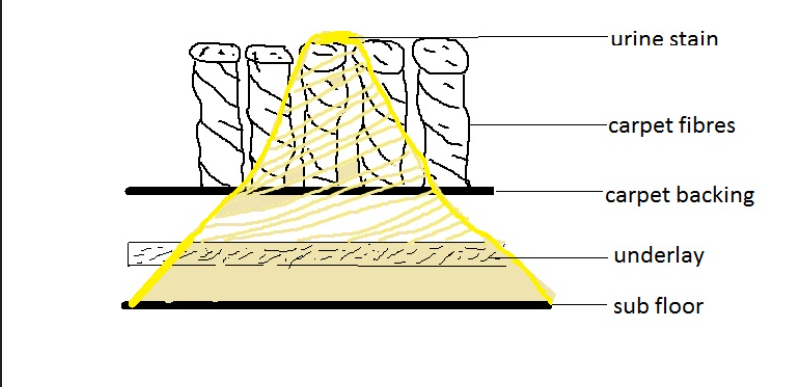
Problems travel far and wide!
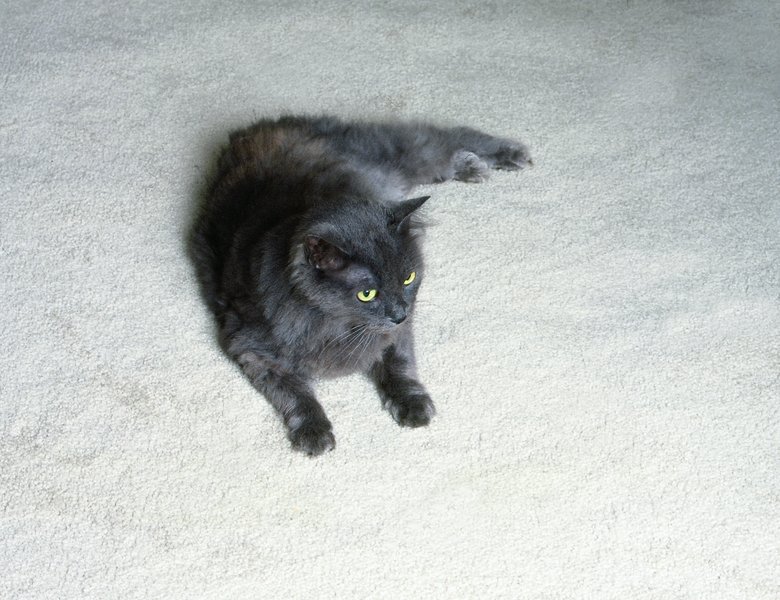
Cats and dogs are drawn back to spots where urine odour remains — even when humans can't detect it. Permanent removal breaks the cycle.
Why Supermarket Products Don't Work
Walk down the pet care aisle of any supermarket and you'll find dozens of sprays, foams, and powders claiming to eliminate pet odours. Most of them work by one of two mechanisms:
- Masking: Adding a stronger fragrance to temporarily cover the smell
- Enzyme-based breakdown: Using biological enzymes to partially break down organic compounds
Neither approach addresses the full problem. Masking products are temporary by definition — the fragrance fades and the urine smell returns. Enzyme-based products can be more effective, but they typically only treat the surface of the carpet. The uric acid crystals deep in the backing and underlay remain untouched.
Warning: Never use steam cleaning to treat pet urine. The heat from steam permanently sets the urine proteins into the carpet fibres — making the stain and odour significantly harder to remove.
The Chem-Dry P.U.R.T.® Solution
Chem-Dry's P.U.R.T.® (Pet Urine Removal Treatment) was developed specifically to address the limitations of conventional pet odour products. It is the most effective pet urine treatment available to residential customers in Australia.
Here's how it works:
-
1UV light inspection. Our technician uses a professional UV light to identify all urine deposits — including those invisible to the naked eye. This is critical, because treating only the visible spots leaves the hidden deposits behind.
-
2Hot Carbonating Extraction pre-clean. We first perform a thorough HCE carpet clean to remove surface contamination, preparing the carpet fibres for the P.U.R.T.® treatment.
-
3P.U.R.T.® application. The treatment solution is applied to all identified urine deposits. It penetrates through the carpet fibres, backing, and into the underlay — reaching the uric acid crystals at their source.
-
4Chemical reaction. P.U.R.T.® initiates an immediate chemical reaction that destroys the uric acid crystals and the bacteria feeding on them. Unlike enzyme products, this is a chemical destruction process — not a biological one that can be disrupted by temperature or pH.
-
5Extraction and drying. The treated area is extracted and left to dry. Because Chem-Dry's process uses minimal moisture, drying time is typically 1–2 hours.
P.U.R.T.® has been independently tested and shown to remove an average of 99.9% of pet urine odours from carpets — permanently, not temporarily.
What About the Stain?
Pet urine stains are a separate issue from the odour. Fresh stains are much easier to treat than old ones. The longer urine sits in the carpet, the more the dye molecules are affected — particularly in wool or wool-blend carpets, where urine can permanently alter the fibre colour.
In most cases, Chem-Dry's treatment significantly reduces or eliminates the visible stain. However, in cases of severe or long-standing contamination, some permanent discolouration may remain even after the odour has been fully eliminated. We will always advise you honestly about what results to expect before we begin.
We walk through every job with our customers — setting realistic expectations and confirming the results before we leave.
First Response: What to Do Immediately After an Accident
If you catch a pet accident fresh, acting quickly can significantly reduce the severity of the problem. Here's what to do:
- Blot — don't rub. Use clean white cloths or paper towels to absorb as much liquid as possible. Press firmly and work from the outside of the stain inward. Rubbing spreads the urine and pushes it deeper into the fibres.
- Apply cold water. Pour a small amount of cold water onto the area and blot again. Repeat 2–3 times. This dilutes the urine concentration.
- Do not use hot water or steam. Heat sets the proteins in urine, making permanent removal much harder.
- Avoid vinegar and baking soda. These are popular home remedies but they don't break down uric acid crystals. Vinegar can also damage some carpet fibres and dyes.
- Call a professional promptly. The sooner a professional treatment is applied, the better the result. Old, dried urine deposits are significantly harder to treat than fresh ones.
How Many Treatments Will I Need?
In most cases, a single P.U.R.T.® treatment is sufficient to permanently eliminate pet urine odour. However, in cases of severe or long-term contamination — particularly where multiple pets have used the same area repeatedly over months or years — a second treatment may be recommended.
Our technician will assess the extent of the contamination during the UV light inspection and advise you on the likely number of treatments required before any work begins.
Prevention: Reducing the Risk of Future Accidents
Once the odour has been permanently eliminated, your pet will no longer be drawn back to that spot by residual scent. This breaks the repeat-accident cycle that many pet owners find so frustrating. To further reduce the risk of future incidents:
- Ensure pets are fully house-trained before being given unsupervised access to carpeted areas
- Consider applying Chem-Dry's Carpet Protectant after treatment — it creates a barrier around carpet fibres that makes future spills easier to clean up before they penetrate
- Address any underlying health issues in older pets that may be causing incontinence
- Schedule regular professional cleaning to maintain carpet hygiene and catch any new deposits early
The Bottom Line
Pet urine odour cannot be permanently eliminated by supermarket sprays, steam cleaning, or DIY methods. The uric acid crystals that cause the smell are bonded deep into carpet fibres and underlay — and only a professional treatment that reaches and destroys those crystals at the source will solve the problem for good.
Chem-Dry Action's P.U.R.T.® treatment is the most effective solution available for residential pet urine odour removal in Sydney. If you're tired of the smell coming back, call us today for a free assessment.
Tired of the Smell Coming Back?
Chem-Dry Action's P.U.R.T.® treatment permanently eliminates pet urine odour — not just masks it. Serving the Northern Beaches and Greater Sydney since 1993.