The Great Carpet Cleaning Debate
When it comes to getting your carpets professionally cleaned, most Sydney homeowners assume steam cleaning is the gold standard. It's been around for decades, it sounds powerful, and almost every cleaning company offers it. But is it actually the best method for your carpets — or is there a smarter, healthier alternative?
At Chem-Dry Action, we've been cleaning carpets across Sydney's Northern Beaches and beyond since 1993 using a fundamentally different approach: Hot Carbonating Extraction (HCE). In this article, we break down exactly how each method works, what the science says, and why the differences matter for your home, your health, and the longevity of your carpets.
How Steam Cleaning Works
Steam cleaning — more accurately called hot water extraction — works by injecting hot water mixed with a detergent solution deep into carpet fibres under high pressure, then immediately extracting it with a powerful vacuum. The heat and pressure loosen dirt, which is then sucked back up along with the water.
It sounds effective, and it can be — but the process has some significant drawbacks that many homeowners only discover after the clean is done.
The Problem with Steam Cleaning
- Excessive water use. Steam cleaning saturates carpets with large volumes of water. Even with powerful extraction, a significant amount of moisture remains deep in the carpet backing and underlay.
- Long drying times. Carpets cleaned by steam can take anywhere from 12 to 48 hours to dry fully — sometimes longer in humid Sydney conditions or poorly ventilated rooms.
- Mould and mildew risk. Moisture trapped in carpet backing and underlay creates ideal conditions for mould incubation. This is particularly concerning in homes with young children, pets, or anyone with respiratory sensitivities.
- Detergent residue. Most steam cleaning solutions contain soaps and detergents that leave a sticky residue in carpet fibres. This residue acts like a magnet for dirt — meaning your freshly cleaned carpets can look grubby again within weeks.
- Re-soiling. Because of the residue issue, carpets cleaned by steam often need to be cleaned more frequently than those cleaned by other methods.
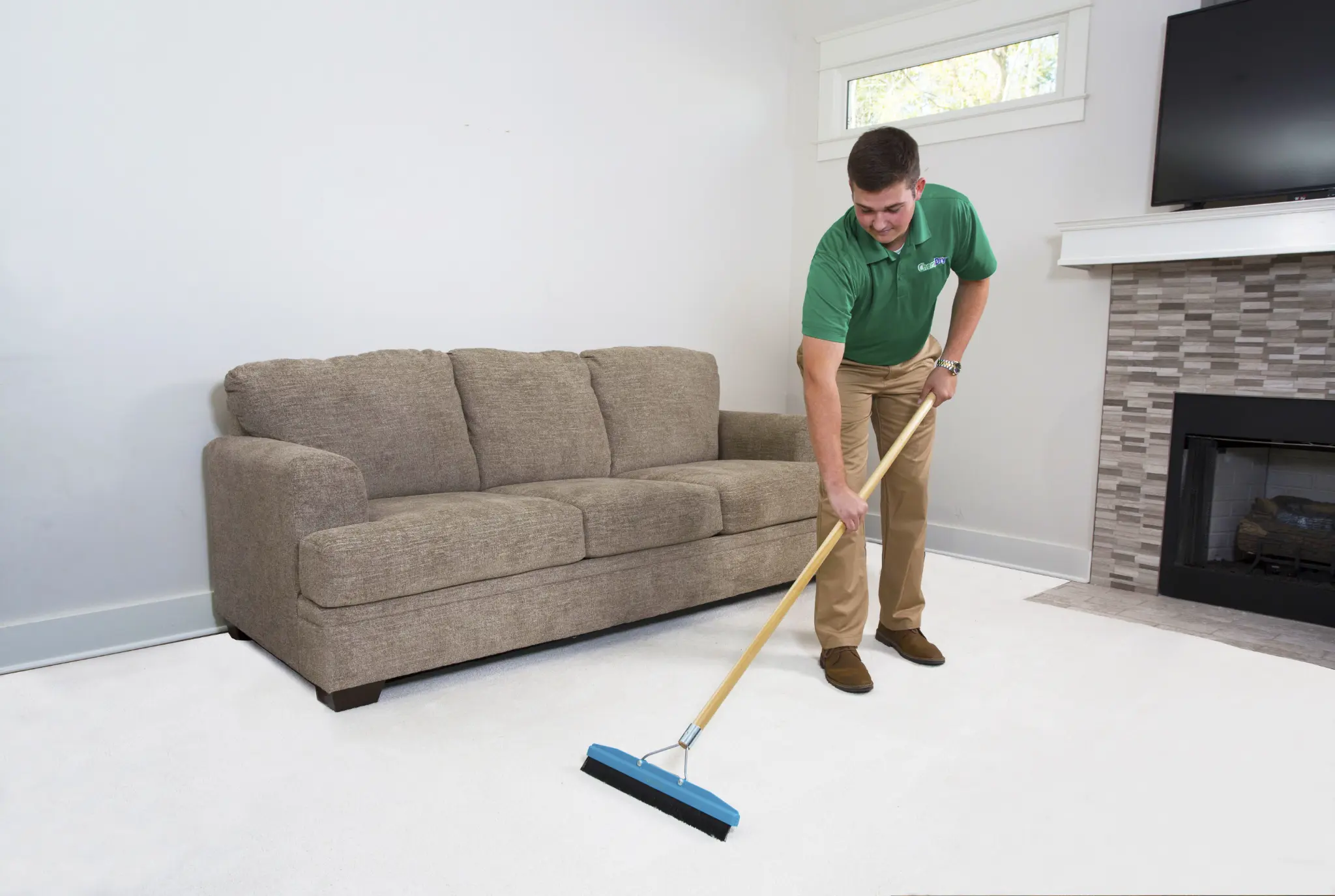
A Chem-Dry technician grooming carpet fibres after a Hot Carbonating Extraction clean — a step that ensures an even, thorough result.
How Chem-Dry's Hot Carbonating Extraction Works
Chem-Dry's HCE process is fundamentally different. Instead of flooding carpets with water and detergent, it uses a carbonating cleaning solution — similar in principle to the carbonation in sparkling water — applied in a low-moisture mist.
The millions of microscopic carbonating bubbles penetrate deep into carpet fibres, attaching to dirt, dust, allergens, and bacteria and lifting them to the surface. The loosened particles are then extracted using Chem-Dry's powerful equipment, leaving carpets genuinely clean — not just surface-clean.
The primary cleaning solution used is The Natural®, Chem-Dry's proprietary, Green-certified formula. It contains no soaps, detergents, or harsh chemicals — just naturally derived carbonating ingredients that are safe for children, pets, and allergy sufferers.
"Chem-Dry's process uses up to 80% less water than typical steam cleaning — meaning your carpets are dry and ready to use in 1–2 hours, not 1–2 days."
Side-by-Side Comparison
| Factor | Chem-Dry HCE | Steam Cleaning |
|---|---|---|
| Drying Time | 1–2 hours | 12–48 hours |
| Water Usage | Up to 80% less water | High volume |
| Mould Risk | Minimal | Significant if not dried quickly |
| Allergen Removal | 98% of common allergens | Variable — no independent standard |
| Airborne Bacteria | 89% reduction | Not independently tested |
| Cleaning Solution | Non-toxic, Green certified, no detergents | Often contains soaps and detergents |
| Residue Left Behind | None — pH neutral | Sticky soap residue common |
| Re-Soiling Speed | Stays cleaner longer | Re-soils faster due to residue |
| Safe for Children & Pets | Yes — immediately after drying | Caution advised with some solutions |
What the Science Says
Chem-Dry's cleaning process has been independently tested and validated by laboratory studies. The results are compelling:
- Chem-Dry's HCE process removes 98% of common allergens from carpets and upholstery — including dog and cat dander and dust mite allergen.
- When combined with Chem-Dry's sanitiser, the process reduces 89% of airborne bacteria in treated areas.
- The Natural® solution is pH neutral, meaning it leaves no sticky residue and does not attract re-soiling the way detergent-based cleaners do.
Steam cleaning has no equivalent independent certification for allergen or bacteria removal. Results vary significantly depending on the equipment used, the operator's technique, and the detergent formulation.

Every Chem-Dry Action job is reviewed with the customer on completion — we don't leave until you're satisfied.
The Mould Problem: Why Drying Time Matters More Than You Think
Sydney's climate — particularly in summer and in coastal areas like the Northern Beaches — creates ideal conditions for mould growth in wet environments. Mould can begin to develop in damp carpet backing within 24–48 hours of a steam clean if the carpet doesn't dry quickly enough.
This is not a theoretical risk. We regularly receive calls from homeowners whose carpets have developed a musty smell or visible mould patches weeks after a steam clean — particularly in bedrooms, lounge rooms with limited airflow, or homes with underfloor moisture issues.
Chem-Dry's low-moisture process eliminates this risk almost entirely. Because so little water is used, there is no opportunity for moisture to penetrate the backing or underlay. Carpets are typically dry within 1–2 hours, even in humid conditions.
Is Steam Cleaning Ever the Right Choice?
In the interest of balance: steam cleaning is not without merit. For heavily soiled commercial carpets where drying time is less of a concern, high-temperature steam can be effective at killing certain bacteria and breaking down heavy grease deposits. In these specific scenarios, it can be a reasonable choice.
However, for residential carpets — particularly in homes with children, pets, allergy sufferers, or any moisture sensitivity — Chem-Dry's HCE process is the superior choice on virtually every metric that matters to a homeowner.
How Often Should You Have Your Carpets Cleaned?
Regardless of which method you choose, regular professional cleaning is essential for carpet longevity and indoor air quality. As a general guide:
- Homes with no pets or children: Every 12–18 months
- Homes with one pet or young children: Every 6–12 months
- Homes with multiple pets or allergy sufferers: Every 3–6 months
- High-traffic areas (hallways, lounge rooms): More frequently than bedrooms
Because Chem-Dry's process leaves no sticky residue, carpets cleaned by Chem-Dry tend to stay cleaner for longer between professional visits — meaning you may actually need fewer cleans over the life of your carpet.
The Bottom Line
Steam cleaning has been the default choice for decades largely because it was the only widely available professional method. That's no longer the case. Chem-Dry's Hot Carbonating Extraction delivers a deeper, healthier clean with dramatically less water, faster drying times, no toxic residues, and independently verified allergen and bacteria removal results.
For Sydney homeowners who care about the health of their family, the longevity of their carpets, and the quality of their indoor air — Chem-Dry is simply the better choice.
Ready to Experience the Difference?
Book a professional carpet clean with Chem-Dry Action — Sydney's trusted specialists since 1993. Fast drying, non-toxic, and guaranteed to satisfy.