Most Australians wash their sheets every week or two — but when was the last time you cleaned the mattress underneath them? For the majority of households, the honest answer is never. The mattress gets made, covered, and largely forgotten. Yet you spend roughly a third of your life lying directly on it, breathing within centimetres of its surface for eight hours at a stretch.
What accumulates inside a mattress over months and years is, frankly, remarkable — and not in a good way. Dust mites, bacteria, mould spores, sweat residue, skin cells, and a range of chemical compounds all build up silently inside the foam and fibres. The consequences range from disrupted sleep to genuine respiratory and skin health problems. This article explains exactly what is happening inside your mattress, how often it should be professionally cleaned, and what you can do between cleans to slow the buildup.
What Actually Builds Up Inside a Mattress
A mattress is not a passive object. It is a warm, humid, protein-rich environment that is ideal for microbial life. Over a 5–10 year period, a mattress can literally double in weight due to the accumulation of organic debris — a fact that surprises most people when they first hear it.
The buildup falls into three broad categories: biological fluids, microbial life, and chemical compounds.
Biological Fluids and Organic Matter
The average person loses up to one litre of fluid per night through perspiration. That moisture — along with the salts, proteins, and oils it carries — is absorbed directly into the mattress surface. Over years, this creates a damp, salty environment deep within the foam layers. Add to this the occasional spill (drinks, food), and in households with children or pets, urine and other body fluids, and the picture becomes clear: the interior of a mattress is far from clean.
Dust Mites and Their Waste
Dust mites are microscopic arachnids that thrive in exactly the conditions a mattress provides — warmth, humidity, and an abundant food source (shed human skin cells). A single mattress can harbour anywhere from 100,000 to 10 million dust mites, according to the Australasian Society of Clinical Immunology and Allergy. Each mite produces approximately 20 waste pellets per day. Those pellets contain a potent protein allergen called Der p1, which is the primary trigger for dust mite allergies.
The key fact: It is not the mites themselves that cause allergic reactions — it is their faecal matter. A single female dust mite lives around 60 days and produces approximately 2,000 droppings during that time. Those droppings remain in the mattress long after the mite is gone.
Bacteria, Mould, and Fungi
The warm, damp interior of a mattress is a productive environment for microbial growth. Common bacteria found in mattresses include Staphylococcus epidermidis (a skin bacterium that can cause infections if it enters a cut) and various soil bacteria tracked in from outside. More concerning are moulds such as Aspergillus fumigatus and Penicillium, which grow in damp spots created by sweat and moisture. These release airborne spores and mycotoxins that can be inhaled during sleep.
Chemical Compounds
Modern mattresses — particularly those made from synthetic memory foam — off-gas volatile organic compounds (VOCs) from the polyurethane, flame retardants, and adhesives used in their construction. These VOCs can cause headaches, dizziness, and throat irritation, particularly in poorly ventilated rooms. Older mattresses may also contain legacy chemicals such as antimony in flame retardants. While modern mattresses are significantly safer in this regard, VOC off-gassing remains a consideration, especially in the first few years of a mattress's life.
How a Dirty Mattress Affects Your Health
Because you sleep with your face close to the mattress surface for eight hours every night, the contaminants inside it have direct and repeated access to your respiratory system and skin. The health impacts are well documented and range from mild to serious.
| Contaminant | Health Impact |
|---|---|
| Dust mite faeces (Der p1) | Allergic rhinitis (morning sneezing, runny nose), eczema flare-ups, asthma attacks, chronic cough |
| Mould spores | Respiratory irritation, worsened sinus infections, hypersensitivity pneumonitis in severe cases |
| Endotoxins (bacterial waste) | Low-grade inflammation, fatigue, brain fog; studies link high endotoxin levels to metabolic issues |
| VOCs (off-gassing) | Headaches, dizziness, nausea, throat irritation during sleep |
| Bacteria (Staph) | Risk of folliculitis or skin abscesses if bacteria enter open cuts or skin irritations |
| Urine / ammonia residue | Airway irritation; promotes further bacterial overgrowth deep in the foam |
One of the most telling signs that your mattress is affecting your health is waking up with symptoms that resolve during the day. If you find yourself sneezing, congested, or with itchy eyes every morning — but feel fine by mid-morning — the problem is almost certainly in your sleeping environment, and your mattress is the most likely culprit.
Higher-risk groups: People with compromised immune systems — including those undergoing chemotherapy, the elderly, and those with HIV — face a more serious risk from mould in old mattresses. Aspergillus mould can cause invasive lung infections in immunocompromised individuals. If anyone in your household falls into this category, professional mattress cleaning and regular replacement are not optional — they are a health necessity.
How Often Should You Have Your Mattress Professionally Cleaned?
The short answer: at least once every 12 months for most households. But the right frequency depends on your specific circumstances. At Chem-Dry Action, we use the following guidelines when advising our Northern Beaches and Sydney customers:
| Household Situation | Recommended Frequency |
|---|---|
| Standard adult household, no known allergies | Once every 12 months |
| Allergy or asthma sufferers | Every 6 months |
| Households with young children | Every 6 months |
| Households with pets (especially if pets sleep on beds) | Every 6 months |
| Elderly residents or immunocompromised individuals | Every 6 months or more frequently |
| After any significant spill (urine, blood, vomit) | Immediately — do not wait for the annual clean |
| Mattress over 8 years old with visible staining | Professional clean + consider replacement |
It is worth noting that regular professional cleaning also extends the usable life of your mattress. A mattress that is cleaned annually will remain hygienic and structurally sound for significantly longer than one that is never cleaned — making the cost of professional cleaning a sound investment compared to early mattress replacement.
What Does Professional Mattress Cleaning Actually Do?
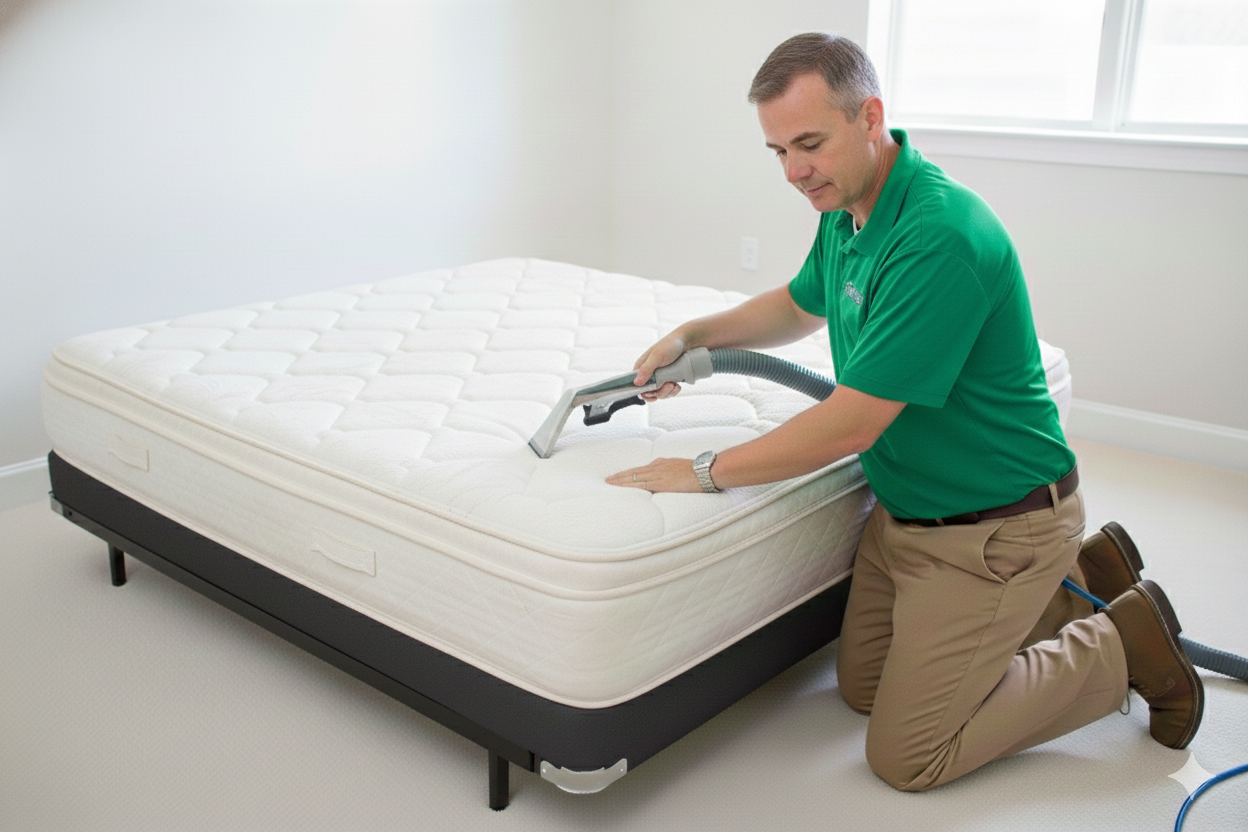
A Chem-Dry Action technician using Hot Carbonating Extraction to deep-clean a mattress — the process reaches contaminants that surface cleaning cannot touch.
Surface cleaning — vacuuming, spot-treating with baking soda, wiping down with a damp cloth — addresses only what is on or near the surface of the mattress. The bacteria, mould colonies, dust mite populations, and embedded organic matter that have worked their way deep into the foam and fibres are entirely unaffected by these methods. Professional cleaning is categorically different.
Chem-Dry Action uses Hot Carbonating Extraction (HCE) — a process that uses the power of carbonation to penetrate deep into the mattress and lift contaminants to the surface, where they are extracted by a powerful vacuum system. The process is applied to all surfaces of the mattress — top, sides, and back — not just the sleeping surface.
The full Chem-Dry mattress cleaning process includes:
- Pre-inspection: Assessment of the mattress condition, identification of stains, problem areas, and any signs of mould or urine contamination.
- Pre-treatment: Stubborn stains and heavily soiled areas are pre-treated with specialist Chem-Dry solutions before the main extraction process begins.
- Hot Carbonating Extraction: Millions of carbonating bubbles penetrate deep into the mattress fibres, breaking up and lifting dirt, bacteria, allergens, and other contaminants to the surface for extraction.
- Sanitisation: A state-of-the-art antimicrobial solution is applied to eliminate bacteria, viruses, and other pathogens — leaving the mattress hygienically clean, not just visually clean.
- Dust mite treatment (optional): For allergy and asthma sufferers, a specialist dust mite treatment is available that targets allergen proteins at the source.
- P.U.R.T.® urine treatment (if required): For mattresses affected by pet or human urine, Chem-Dry's P.U.R.T.® (Pet Urine Removal Treatment) permanently eliminates urine odours rather than masking them.
Dries in hours, not days: Because Chem-Dry's HCE process uses up to 80% less water than traditional steam cleaning, your mattress is dry and ready to sleep on within a few hours — not the 24–48 hours that steam-cleaned mattresses typically require. This also means there is no risk of the mattress remaining damp long enough to develop new mould growth — a genuine risk with high-moisture cleaning methods.
What to Do Between Professional Cleans
Professional cleaning once or twice a year handles the deep contamination that household methods cannot reach. Between those cleans, a consistent maintenance routine will slow the rate of buildup and keep your sleeping environment healthier.
Daily and Weekly Habits
The single most effective thing you can do is use a 100% waterproof mattress protector — not just a fabric cover, but a genuine waterproof encasement. This blocks sweat, spills, dust mites, and bacteria from reaching the mattress itself. Wash the protector every two weeks. Strip and wash your sheets weekly in water at 60°C or above — cold water does not kill dust mites or bacteria. Each morning, pull back the duvet and open a window for 30 minutes to allow moisture to evaporate from the mattress surface.
Monthly Maintenance
Every time you change your sheets, vacuum the mattress surface using an upholstery attachment with a HEPA filter. Pay particular attention to the seams, where dust mites tend to concentrate. A baking soda treatment — sprinkling a generous layer over the entire mattress, leaving it for several hours, then vacuuming thoroughly — absorbs residual moisture and neutralises odours. For fresh spills of blood, urine, or sweat, use an enzymatic cleaner: blot (never scrub) the spill, apply the cleaner, and dry the area completely with a fan. A mattress that remains damp for more than 24 hours will begin to develop mould.
Warning Signs That You Need Professional Cleaning Now
Do not wait for your annual clean if you notice any of the following:
- A persistent musty or sour smell that returns despite baking soda treatment
- Visible yellow sweat stains that have darkened to brown or grey
- New or worsening morning allergy symptoms — sneezing, itchy eyes, nasal congestion
- Dark spots or speckles on the mattress surface (mould colonies)
- Any urine contamination from a child, pet, or incontinence incident
When Cleaning Is Not Enough: Knowing When to Replace
Professional cleaning is highly effective, but it is not a substitute for mattress replacement when a mattress has reached the end of its useful life. As a general rule: if your mattress is over eight years old, has visible staining across a significant area of the surface, and you wake up congested or in pain every morning, it is time to consider replacement.
A mattress that has been saturated with eight or more years of sweat, mite waste, and biological fluids has reached a point where even professional cleaning cannot fully restore it to a hygienic state. The foam structure itself degrades over time, losing its support properties and becoming increasingly difficult to clean effectively. In these cases, the right advice is to replace the mattress — and to start the new one off correctly with a waterproof protector and a regular cleaning schedule from day one.
For mattresses that are still within their useful life — typically under eight years old and without extensive structural damage — professional cleaning is an excellent investment. It restores hygiene, removes allergens, eliminates odours, and extends the mattress's usable life. For Northern Beaches and Sydney families, Chem-Dry Action has been providing this service since 1993.
Book a Professional Mattress Clean Today
Chem-Dry Action serves the Northern Beaches, North Shore, and Greater Sydney. Our Hot Carbonating Extraction process deep-cleans and sanitises your mattress — and it's dry within hours. Call us or request a free quote online.